
Doomers get clicks, optimists make money


Lately, I’ve been more and more inclined to agree with this thought by Ed Finley–Richardson @ed_fin.
I’ve long noticed that the headlines are becoming more and more biased and “louder,” while the analytics underneath are becoming more shallow than ever.
For instance, if we look at the headlines related to artificial intelligence in recent years, the picture is far from attractive:
→ “AI bubble is coming…”
→ “AI bubble is bigger than dotcom…”
→ “AI bubble is about to burst…”
→ “Stock market could go into freefall…”
→ “Bank of England warns…”
→ “It’s not IF it bursts anymore…”
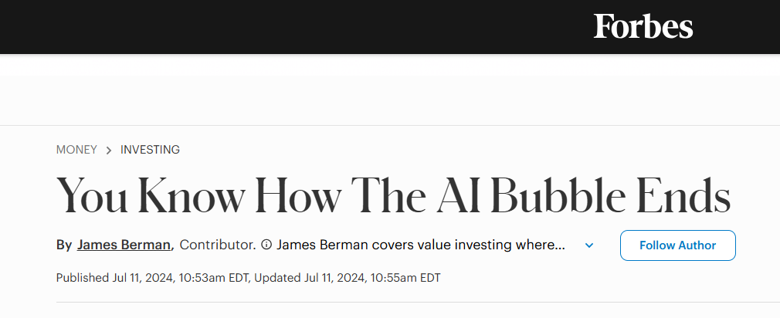
I understand that “clicks have to be traded somehow”, but everything has its measure and limit. I’m not saying that there are no good articles, but I get the feeling that these “doomsday” articles “get to the front pages more often” and get more clicks. If we compare them with the “dot-com bubble”, then I would say – yes, it burst. But the Internet did not burst!
That's how I look at this AI "issue". Only this time we clearly see technology that has already proven its practical contribution, accessible even for ordinary folks, not just big corporations.
Let me give you a very simple example from my own experience. More than a year ago, I started creating my website with the idea of selling trading training courses. All of this took much more time than I had originally planned. I wrote the entire training program, changed and supplemented it several times, filmed a video, worked on the website, and went through all the usual headaches that arise when you try to turn an idea into a real product. The course itself has not become outdated or irrelevant during this time. Because the course is designed to be universal at any time. Trading has not suddenly disappeared anywhere either. Something else has changed. People's perception of learning has changed. Why watch a training course for hours? Why read a 300-page book? Why learn Excel, programming, statistics, or technical analysis? Just ask artificial intelligence. It will explain everything. It will analyze everything. And, apparently, very soon it will also be making money for you, while you calmly drink coffee on the beach. :)

At least, that's the main impression that prevails at the moment. It's so easy until you really have to do it!
Unfortunately, that's not how it works. The ability to get an answer instantly is not the same as knowledge.

And access to intelligence doesn't automatically make you intelligent. Trading is actually a great example. You can ask an artificial intelligence to explain in detail a company's balance sheet, financial statements, price charts, RSI, market cycles, risk management, or practically anything else. You can even upload a chart and ask it what it thinks about it. But then, sooner or later you have to start trading with your own money to actually enter he market.
The market where you experience that When your chosen investment: stocks or other financial instruments starts falling. When the headlines scream against your open market position. Then things get tough and you want to hear some quality and balanced advice. And in an instant, you realize - suddenly, having ChatGPT or Claude or some other AI tool open somewhere in your browser doesn't miraculously give you ten years of experience in the financial markets.
Knowledge, experience, and the ability to make independent decisions still matter. Perhaps even more than many would like to admit at the moment. But at the same time, this does not mean that artificial intelligence is just another hype. In fact, quite the opposite.
When we step back from the idea that AI will simply “do everything for us” and look at what it can actually do today, the picture becomes much more interesting: Programming; Data processing; Working with documents; Writing and editing texts; Translation; Creating and editing images; Researching and collecting information; Automating relatively simple everyday tasks. Things that used to require different programs, different skills, and sometimes even several people, can increasingly be done in one environment - and often within a matter of minutes. This is a huge change! And it has happened incredibly quickly.
In this sense, artificial intelligence has not simply added another useful tool to the Internet. It has turned the Internet upside down. For the past twenty years, we've been learning how to search for information on the Internet. Go to Google. Type in the right keywords. Find ten links. Open five. Ignore three ads. Read two articles. Try to figure out which one is actually true. And then try to piece all that information together by yourself. Now, more and more, we're just asking a question. At first glance, that might not seem like a big difference. But it's a fundamental shift in how people interact with information.
And that's why I find it hard to believe the seamingly convincing claims that we're simply watching another bubble and the only unanswered question is when it will burst. Maybe AI company stocks are really in a bubble. Maybe some companies' valuations are completely absurd. Maybe half of today's AI companies won't even exist in ten years. All of this is entirely possible.
But the technology itself?
The dot-com bubble burst. The Internet didn't...
And perhaps we're making the same mistake again - confusing the speculation that has arisen around a technological revolution with the technological revolution itself. Right?
And here, I think, we can conclude the following: AI does not reduce the value of knowledge, but paradoxically - increases it! Because obtaining information becomes almost worthless. However, the ability to understand whether the information obtained so easily is even meaningful is becoming increasingly valuable.
How information retrieval has evolved:
• The library era: find the right book → read → take notes → compare with other sources → draw conclusions.
• The Google era: enter keywords → find dozens of sources → filter → read → compare → draw conclusions.
• The AI era: ask a question → get a ready-made answer.
So a huge part of the work between the question and the answer simply disappears. And here begins the paradox.
In the past, the very process of obtaining information forced you to learn something. By the time you read three books or ten articles found on Google, some understanding of the topic inevitably formed in your head. You saw contradictions. One author claimed one thing, another something completely opposite. You had to think for yourself. AI can simply skip this stage. And it is fantastically effective. But it comes at a price. You can get from a question to a very convincingly formulated answer without really learning anything along the way. How can you challenge AI if you don't know enough to understand when AI is wrong?
If AI can write another article about “10 best trading strategies for beginners” in five seconds, then the Internet doesn’t need another 50 million such articles. Their value approaches zero. On the other hand, a person who says: “I’ve been doing this for 10 years. Here’s what I’ve tried. Here’s where I went wrong. Here’s what the theory says, and here’s what happens in real life.” — suddenly becomes much more interesting. Because AI can perfectly process already existing information. However, experience, a new experiment, new data, personal observation, and an original thought must first be created somewhere. That’s why I would even turn the original argument upside down: The cheaper becomes information, the more valuable becomes knowledge. Does AI make answers cheap. It doesn’t make judgment cheap.
Let's look at those headlines again:
AI boom

AI bubble

And another one AI bubble

And one more bubble...
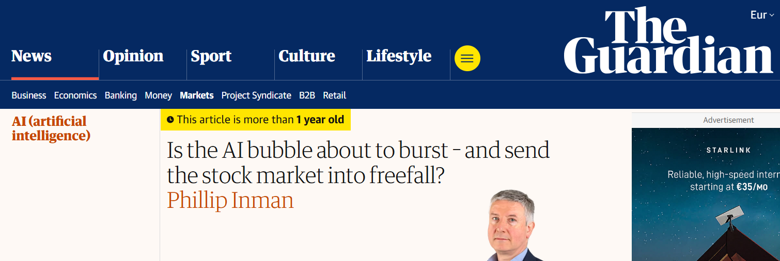
Read enough of these headlines, and sooner or later you too will start looking at the market with a rather suspicious expression on your face. Everything is overvalued. Everything is a bubble. Everything is about to collapse. There's just one slightly inconvenient detail: stock prices keep going up.
Sure, you can keep screaming that everything is bad. And you can do that for a very, very long time. And eventually — you'll be right. That's guaranteed. Because markets don't go up forever. There's going to be another correction. There's going to be another bear market. And sooner or later, there's probably going to be another proper market crash, which will scare everyone again. And then, when it finally happens, the person who predicted this crash years ago will proudly step forward and say, “SEE! I TOLD YOU SO!” And technically, he’ll be right. Finally.
The only thing he’ll probably forget to mention is what happened to the market all those years while he waited for the moment when he was finally proven right. It’s one of the strangest things about financial markets. You can be absolutely accurate about the outcome and still lose a lot of money along the way, or miss out on the opportunity to make a lot of money. Because the market doesn’t pay you for the most dramatic opinion. It doesn’t pay you for being the smartest person on X (Twitter). And it certainly doesn’t pay you for correctly predicting seventeen of the last three market crashes. Just think about it for a while.
The market pays for good decisions. And that’s a huge difference. So while one person is standing on the sidelines, reading another scary headline and waiting for the inevitable crash that will finally prove them right, somewhere in the background, another person is doing something much less exciting: Looking at the data; Following the trend; Controlling risk; Using their knowledge and experience; And looking for the next opportunity to make money. Not because they believe that markets can only go up. Not because they think that AI company valuations don’t matter. And certainly not because they believe that nothing bad can happen. But because they understand one pretty simple thing: Being aware of the risks and constantly betting on disaster are two completely different things.
And when will the correction finally come? The pessimist (the Doomer) will have his big moment. He will have been Right. He will finally be able to announce very, very loudly how right he was all along. Meanwhile, the other person — with their own perspective, knowledge, and experience — will probably look at the falling market with the smile... and start looking for the next opportunity.
Doomers get clicks. Optimists make money.
Stay tuned!
Agris


Comments